
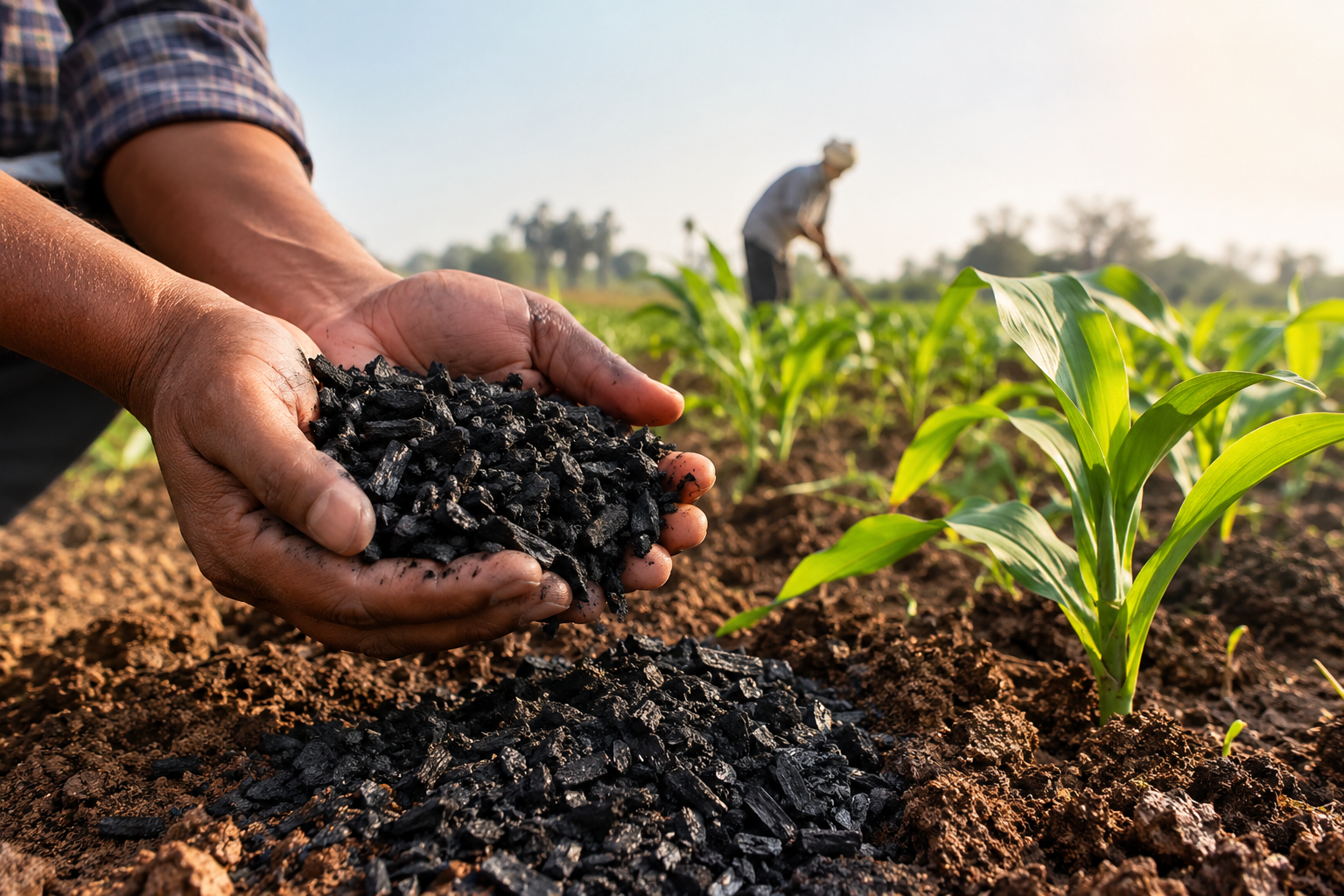
Biochar deals with the source control and managing the appropriate and committed use of specific biochar ingredient fractions that can stabilize 20–30% of biochar in soil for long periods (centuries, millennia) for carbon sequestration and enhance soil-water retention (10–30%) for soil productivity management.
It has proved by experience (from 2004) to be an incremental, affordable, and scalable adoption by smallholders in India. Among others, these include crop residue management of maize cobs, maize stalk, sugarcane bagasse, paddy, rice husks, cotton stalks, groundnut shells, and mustard & soybean residues.
Linkages with innovative delivery models such as Aadi (Punjab & Haryana), GFCAM (Karnataka), and SALM (Uttar Pradesh) would also help position biochar as a bankable climate smart-Agriculture intervention.
Challenges for Smallholder Farmers
Smallholder farmers encounter two interconnected barriers:
- Lack of capital: The investment needed for pyrolysis units, feedstock logistics, and application labor cannot be met by smallholder farmers (<1 ha).
- Market exclusion: Plots alone do not produce enough carbon credits to justify the MRV and verification costs. Buyers want big, uniform portfolios.
Market failure: such a high-impact climate solution remains largely absent while significant agronomic and mitigation co-benefits exist.
Biochar as a Long-Lived Carbon Sink
Biochar’s climate benefit depends on its chemical stability. Pyrolysis transforms the organic material of biomass into a highly aromatic, condensed carbon molecule that is difficult for microbes to consume.
Research shows:
- Mean residence time (MRT): Hundreds to thousands of years in temperate and tropical soils.
- Carbon retention: 74–90% of initial biochar carbon remains after 100 years; decomposition rate averages of ~0.3% / year.
- Permanence classification: Biochar is considered “long-lived” (centuries to millennia) carbon removal under new frameworks (e.g., EU CRCF).
This high persistence makes biochar different from low-turnover soil organic carbon practices and eligible for high quality carbon credits.
Agronomic Co-Benefits: Water, Fertility, Yield
Beyond sequestration, biochar delivers immediate farm-level gains:
- Water retention: 10–30% increases in soil water-holding capacity reported by meta-analyses; some trials show 37–47% increase in plant-available water.
- Soil Physical Properties: Improved pore size distribution, lower bulk density, better soil aeration & water retention. Soil Chemical Properties: Higher CEC, more efficient microbial activity, NPK retention.
- Yield response: Tropical, acidic soils show ~38% yields; systems where drought occurs are aided by less stress of water stress.
In large cereal, cash-crop and pulse-based production systems — especially those dominated by maize, sugarcane, rice, cotton, groundnut, mustard and soybean — the conversion of specific waste fractions (cobs, stalks, bagasse, straw, husks, shells) into biochar can add value to agricultural wastes while also generating a new source of revenue.
Conventional practices in some of these crops include open burning and for inefficient disposal of post-harvest residues causing a number of environmental issues.
Policy Solution: Aggregate Carbon Credits at the State Level
Institutional Architecture
Models already tested in Karnataka under the Government-Facilitated Carbon Aggregation Model (GFCAM). Could be modified and applied as per context.
- State Carbon Authority (SCA): To operate under the Agriculture/Climate Department; will be the manager of project registration, buyer negotiations, and revenue sharing.
- District Carbon Facilitation Cells (DCFCs): To perform MRV, collate village-level data and administer logistics such as biochar production centers and biochar application timings.
- Village Carbon Committees (VCCs) / FPOs: Register farmers, check application, and transfer payment through digital bank account.
To be aligned with the SALM program in UP that has a tri-partite structure of state policy, validated by IIT Roorkee, and industry linkage of ~778,000 holdings.
Technical Standards
- Approach: Follow Verra VM0042 (Improved Agricultural Land Management) for soil carbon quantification and the new, biochar-specific methodology for permanence aspects of certification.
- MRV Protocol: Geotagging of application records, periodic samples of soils (dry combustion or NIR/MIR spectroscopy), third-party verification.
- Application Rates: 5–10 t/ha as recommended on the packaging depending on soil texture and the crop.
Financial Mechanism
- Aggregation Scale: 500–1,000 farmers per district project to generate tradable credit volumes; and distribute transaction costs.
- Upfront Financing: Arrange contracts to provide 50–60% of expected credit revenue up front (or as milestone payments based on verified application).
- Revenue Sharing: Divided fairly and transparently for instance: 70% to farmers, 20% to aggregator and MRV, 10% to state facilitation fund.
Relevance as National Priorities
- Net-Zero by 2070: CDR Gigaton potential of biochar.
- National Mission for Sustainable Agriculture (NMSA): Improves soil health and water use efficiency, increases resilience to climate change.
- Soil Health Card Scheme: Biochar suggestions were incorporated into the soil advisory services of the state.
Roles & Responsibilities of Stakeholders
| Stakeholders | Role | Key Responsibilities |
|---|---|---|
| State Agriculture Department | Lead Agency | Policy approval, fund allocation, inter-departmental coordination. |
| State Climate Change Authority | Technical Oversight | Align with state climate action plans; ensure MRV integrity. |
| District Collectors | Implementation Lead | Mobilize DCFCs; resolve land/logistics bottlenecks. |
| Krishi Vigyan Kendra’s (KVKs) | Extension Arm | Train farmers; conduct demo plots; monitor agronomic outcomes. |
| FPOs / Village Carbon Committees | Grassroots Aggregation | Enroll farmers; verify application; disburse payments. |
| Pyrolysis Hub Operators | Biochar Supply | Produce quality biochar; manage feedstock logistics. |
| Third-Party Verifiers (Verra-accredited) | MRV Validation | Audit soil carbon claims; issue credits. |
| Corporate Buyers | Credit Off-take | Pre-purchase credits; provide ex-ante financing. |
Legal & Regulatory Considerations
- Land Tenure: Provide farmers with definitive land title documents or lease agreements, meeting the project’s standards for qualifying for carbon credits (as per VM0042).
- Feedstock Sourcing: Adhere to all biomass-collection standards and develop a verifiable system to source maize cobs and stalks, paddy straw, rice husks, sugarcane bagasse, cotton stalks, groundnut shells, mustard stalks, and soybean residues (specifically for feedstock that is not diverted for use as fodder for domestic animals or as source of domestic fuel).
- Carbon Credit Ownership: Define clear contracts specifying farmer vs. aggregator vs. state shares of credit revenue.
- Taxation: Explain treatment of GST/income tax of income from carbon credit income for smallholders (probably exempt by category of income — agricultural).
Possibilities for Adoption in Different States
- Multi-Crop Residue Areas: Uttar Pradesh, Haryana, Punjab, Bihar, Madhya Pradesh and Rajasthan focusing on the collection and conversion of maize cobs, maize stalks, paddy straw, rice husks, cotton stalks, groundnut shells, mustard stalks and soybean residues.
- Rice-Wheat Systems: Adapt the framework for the production of biochar from paddy straw and rice husks, especially in situations where residue burning is prevalent, by bringing in the other region-appropriate residues like mustard stalks and cotton stalks.
- Horticultural and Plantation Zones: Use biochar in orchards and for perennial crops (e.g., mango, guava, coffee, tea, citrus), including orchard and plantation residues (fruit-tree pruning’s, nut husks, coconuts, etc.) that are readily available in your area.
Key Takeaways
- Biochar is a unique intersection of climate, soil health and rural livelihoods. The technology is well established, the science is solid, and markets for high integrity carbon removal are expanding.
- A policy mechanism is needed that allows scale-up of smallholder farmers to participate in carbon markets.
- States have a chance to lead by aggregating smallholdings, unifying MRV and structuring upfront payments, they can scale biochar into a mainstream climate-smart agriculture practice.
- State-level programs (such as the SALM program in Uttar Pradesh and soil carbon payments in Punjab and Haryana) have demonstrated that the model works.
- This could serve as a rural welfare plan, soil welfare mission, and a farmer income scheme-in for many states.